Share this post:

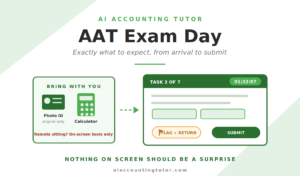 AAT exam day anxiety is mostly fear of the unknown. Students who have done the revision still lie awake wondering about the mechanics: what happens when I arrive, what does the software look like, can I go back to questions, what if my pen runs out, what if the internet drops mid-exam at home. None of that uncertainty needs to exist, because every part of the day follows a predictable script.
This guide walks through AAT exam day from the night before to clicking submit, for both test centre sittings and remote invigilation, including the rule differences between the two that surprise almost everyone (starting with your calculator).
On AAT exam day itself, arrive 15 to 20 minutes early. The invigilator checks your photo ID against the booking, signs you in, and directs you to lock away your belongings, including your phone. You will be shown to a computer workstation, usually with scrap paper provided by the centre (which must be handed back at the end, so do not write anything you want to keep).
The invigilator starts your AAT exam day assessment for you or gives you a login. Before the timer begins you typically see an introduction screen confirming the assessment name, duration and task count. Read it. Students in exam-brain have started the wrong mental model because they skipped thirty seconds of orientation.
AAT computer-based assessments follow a consistent format across units, which is excellent news: familiarity from one AAT exam day carries to the next.
The 70% pass mark punishes unfinished papers more than imperfect answers, which shapes the right AAT exam day timing plan. The approach that consistently gets students through AAT exam day:
Sitting your AAT exam day at home swaps travel stress for procedure. The session starts with identity and environment checks: you show your photo ID to the camera and use your webcam to scan the room, proving no notes, second screens or helpful relatives are present. Then the differences begin, and they matter:
A remote AAT exam day suits students far from a centre or with schedules that need evening and weekend slots. They punish the unprepared setup, not the unprepared student.
Once AAT exam day ends, venue-sat computer-marked assessments deliver results to your MyAAT account by the end of the next working day; remote sittings take up to 10 business days; human-marked elements take longer. Our AAT results guide covers every timeline, the 70% pass mark and how grades are calculated, and if the result is not the one you wanted, the AAT resit guide turns the feedback into a recovery plan. Booking details, fees and notice periods for your next sitting live in our AAT exam booking guide.
At a test centre: current original photo ID (passport, photocard driving licence or residence permit), a calculator that cannot store or display text, and pens. Scrap paper is provided and collected back. Phones and smartwatches are banned from the exam room. Without valid ID you cannot sit the assessment.
At a test centre, usually yes, provided it cannot store or display text. Under remote invigilation, no: you must use the on-screen calculator, with workings on a digital scratch pad. Practise with the on-screen tools before a remote sitting.
Yes. AAT assessments let you navigate freely between tasks, flag anything doubtful and return before submitting. Nothing locks when you move on, which is why answer-everything-flag-the-doubtful is the right strategy under a 70% pass mark.
Brief blips are usually survivable, but significant instability can flag the sitting for investigation. Use the most stable connection available, ideally wired, and minimise other household internet use during your slot. If a session fails, contact your training provider and AAT promptly.
Fifteen to twenty minutes before your slot at a venue, allowing for ID checks and locker arrangements. For remote sittings, be system-checked and seated ahead of your start window with the room already cleared and the household briefed.
The students who walk out of AAT exam day happy are rarely the ones who knew the most. They are the ones for whom nothing on screen was a surprise: the task formats, the on-screen calculator, the timing rhythm, the flag-and-return workflow. That familiarity is entirely trainable in advance.
AI Accounting Tutor gives you unlimited AAT-style practice tasks in the same formats you will meet on the day, with instant worked solutions and a difficulty engine that targets your weak areas until they stop being weak. Start your subscription and make exam day the most familiar part of the qualification. For official assessment regulations, see the AAT website.
Support Team
I will be back soon


