Share this post:

 Every AAT student wants the same thing: to pass AAT exams first time, without the stress, the resit fees, or the months of lost momentum. The good news is that students who pass AAT exams consistently tend to do a handful of things differently, and none of them involve natural talent. They involve a smarter way of revising.
At AI Accounting Tutor, we support AAT students every day, at every level, and we see exactly where marks are won and lost. This guide brings that experience together: how AAT exams work, the seven revision strategies that make the biggest difference, a simple weekly study plan, and what to do if an exam doesn’t go your way.
AAT qualifications are assessed through computer based exams, taken at approved exam venues or, for some assessments, remotely. Most unit assessments are marked automatically, so you usually receive your result quickly. Questions test practical skills: posting journals, completing ledgers, calculating costs, and interpreting financial information, rather than writing long essays.
That format matters for your revision. To pass AAT exams, you need to be able to do accounting under time pressure, not just recognise the right answer when you see it. Everything that follows is built around that principle. For the official structure of each qualification, the AAT website is the definitive source.
Download the assessment guidance for your unit and look at sample assessments early. When you know how questions are asked, every hour of revision becomes targeted. Students who walk in already familiar with the software layout and question styles pass AAT exams at a visibly higher rate than students seeing the format for the first time on exam day.
Forty five focused minutes a day beats a five hour panic session on Sunday. Accounting knowledge is cumulative: double entry underpins ledgers, ledgers underpin trial balances, and so on. Short daily sessions keep every layer fresh. Consistency, not intensity, is what gets students through.
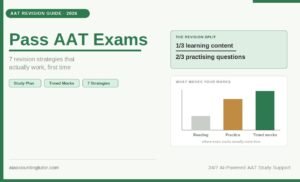
Reading a chapter feels productive, but it’s the weakest form of revision. The strongest is attempting questions, getting them wrong, and understanding why. Aim for a rough split of one third learning content and two thirds practising it. If you only change one habit after reading this article, make it this one.
Almost every AAT exam leans on double entry bookkeeping. If you still pause to think about which side is the debit, you’ll lose time and confidence in the exam. Drill it until it’s reflex. Once double entry is automatic, whole categories of questions become easy marks.
Mocks do two jobs. They expose your weak topics while there’s still time to fix them, and they train your exam timing. Sit at least two full mocks per unit, timed, with no notes, and mark them honestly. Then spend your remaining revision time on the questions you got wrong, not the ones you got right.
The biggest silent killer of AAT progress is the unanswered question. You hit a concept that won’t click, there’s no tutor available until next week, and revision stalls. This is exactly why we built the AI Accounting Tutor: a study companion that explains any AAT topic in plain English, works through examples step by step, and never gets tired of you asking “but why?” at 11pm. Momentum is everything in revision, and instant answers protect it.
Sleep properly the night before, arrive early, read every question twice, and answer the easy questions first to bank marks and settle your nerves. If a question stalls you, flag it and move on. Marks are spread across the whole paper, and time management alone decides more results than most students realise.
Here’s a realistic weekly rhythm for someone studying around work or family. Adjust the days to fit your life; the pattern is what matters.
| Day | Session (45 to 60 minutes) |
|---|---|
| Monday | Learn one new topic, then attempt 5 questions on it |
| Tuesday | Practice questions only, on this week’s topic |
| Wednesday | Review mistakes, ask about anything unclear until it clicks |
| Thursday | Practice questions on an older topic, to keep it fresh |
| Friday | Rest, or light reading of next week’s topic |
| Weekend | One longer session: mixed questions, or a timed mini mock |
In the final three weeks before your exam, shift almost entirely to timed mocks and reviewing errors. By that stage, practising beats learning anything new.
The AI Accounting Tutor is a study subscription built specifically for AAT students, for £9.99 a month. It works alongside whatever course or provider you study with. Whenever you’re stuck, you ask, and it explains: in plain English, step by step, with worked examples, as many times as you need. It’s available 24/7, so your revision never stalls waiting for an answer, and it adapts its explanations until the concept actually makes sense to you.
Students use it to untangle double entry, work through costing methods, prepare for mocks, and rebuild confidence after a wobble. Think of it as having a patient tutor in your pocket for less than the cost of a takeaway. You can see how it works at aiaccountingtutor.com and full details on our pricing page.
First, breathe. A failed unit is a delay, not a verdict. AAT exams can be resat, and many successful accountants failed a unit somewhere along the way. Look at your feedback, identify the topic areas that let you down, and rebuild your revision around them using the strategies above. Students who treat a resit as targeted repair work, rather than repeating the same revision and hoping, usually pass AAT exams comfortably the second time.
You don’t need more hours to pass AAT exams. You need the hours you already have to work harder for you: practice over reading, mocks over hope, and instant answers instead of week-long waits. If you’d like a study companion for the journey, you can start with the AI Accounting Tutor today for £9.99 a month.
AAT exams are very achievable with consistent revision. They test practical skills through computer based assessments, and most students who practise questions regularly, sit timed mocks, and resolve their weak topics before exam day pass AAT exams without difficulty. Pass rates for each unit are published by AAT.
Practise questions early and often. Spend roughly one third of your time learning content and two thirds attempting questions, sit at least two full timed mocks per unit, and get stuck concepts explained immediately rather than letting them pile up.
Short, frequent sessions over several weeks work far better than cramming. Around 45 to 60 minutes a day, five or six days a week, with the final three weeks focused on timed mock exams, is a realistic and effective pattern for most students.
Yes. AAT unit assessments can be resat. Review your feedback, target the topics that cost you marks, and change how you revise rather than just repeating it. Many students pass comfortably on their second attempt.
The AI Accounting Tutor is a £9.99 per month study subscription for AAT students at aiaccountingtutor.com. It explains any AAT topic in plain English, works through examples step by step, and is available 24/7, so you get unstuck the moment a concept confuses you.
No. It works alongside your course or training provider as a revision and support tool. Your provider delivers the qualification and exams; the AI Accounting Tutor makes sure you always have somewhere to turn when you’re stuck between classes.
Double entry bookkeeping underpins most AAT exam questions, from ledgers to trial balances. Students who make double entry automatic answer faster, make fewer errors, and free up exam time for harder questions, which is why it’s the single most valuable topic to master early.
AAT computer based assessments use a mix of question styles, including numerical entry, completing ledgers and tables, matching, and some multiple choice. That’s why practising in the exam format matters more than memorising notes.
Support Team
I will be back soon


