Share this post:

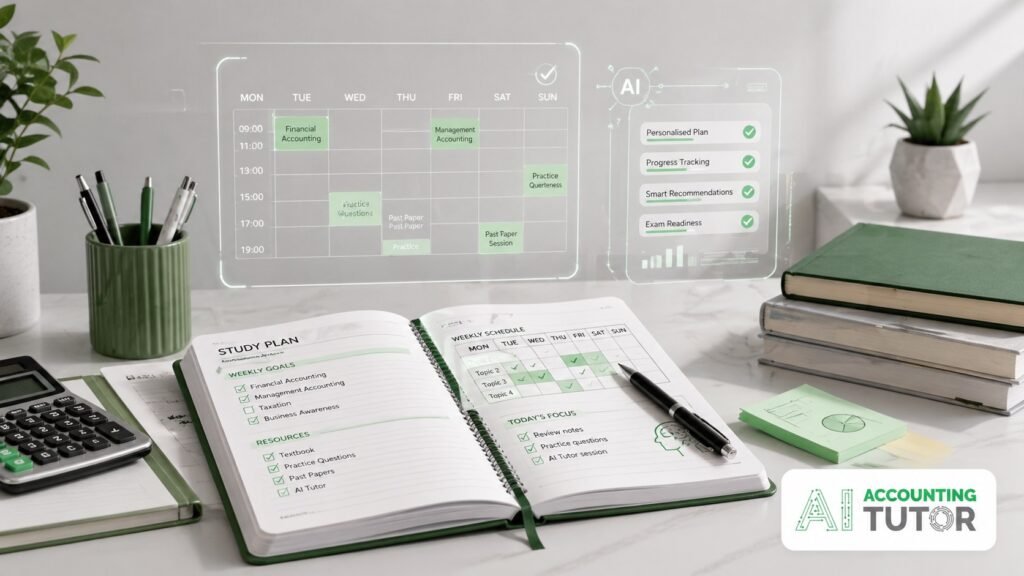
Studying for AAT can feel overwhelming when you do not know what to revise first.
One day you are reading about double-entry bookkeeping. The next day you are trying to remember costing formulas, journals, accruals, prepayments, VAT rules or financial statements. It can quickly feel like your revision is scattered across too many notes, videos, questions and unfinished chapters.
That is where an AI AAT study plan can make a real difference.
Instead of guessing what to study next, an AI AAT study plan helps you organise your revision around your actual progress. It gives structure to your week, helps you focus on weak areas, and turns your study time into something more practical and purposeful.
At AI Accounting Tutor, our goal is simple: to help accounting students revise more effectively, practise with confidence and build the skills they need for their exams.
You can explore AI-powered accounting support here: AI Accounting Tutor
AAT exams are not just about remembering theory. You need to understand how accounting works, apply rules correctly, answer practical questions and manage your time under exam conditions.
AAT assessments are computer-based, and students need to be ready for the structure and expectations of the assessment environment. You can read more about how AAT assessments work on the official AAT website here: AAT assessments: how they work
The problem is that many students revise reactively. They study whatever feels urgent, whatever seems easiest, or whatever they are most nervous about. That can lead to a lot of effort without enough progress.
An AI AAT study plan gives your revision a direction. It turns “I need to revise” into “Today I need to practise bookkeeping controls, review my mistakes, and complete five exam-style questions.”
That tiny shift matters.
The first step in building an AI AAT study plan is knowing exactly when your exam is.
If your exam is six weeks away, your revision plan should look very different from someone who has six months. AI can help you break your time into manageable study blocks, but it needs a clear target.
For example, a student with four weeks before an exam might use this structure:
Week 1: Review core topics
Week 2: Practise questions by topic
Week 3: Focus on weak areas
Week 4: Complete timed mock-style practice
An AI AAT study plan works best when it starts with the end goal and works backwards.
A strong AI AAT study plan should include every topic in your unit, not just the ones you enjoy.
This is important because students often over-revise the topics they already understand. It feels productive, but it does not always improve your exam result.
For example, if you are studying AAT Level 2, you may need to cover areas such as bookkeeping transactions, bookkeeping controls, costing, business environment and accounting principles. At Level 3 or Level 4, the topics become more advanced and require deeper application.
Your AI AAT study plan should separate topics into three groups:
Confident topics
Unclear topics
Problem topics
This gives you a much clearer picture of where your revision time should go.
One of the biggest advantages of an AI AAT study plan is that it can help you spot patterns in your mistakes.
Traditional revision often tells you whether you got a question right or wrong. AI-powered study support can go further by helping you understand why you got it wrong.
Did you misunderstand the question?
Did you apply the wrong rule?
Did you rush the calculation?
Did you forget a key accounting principle?
Did you know the topic but panic under pressure?
That kind of feedback is gold dust for AAT students.
An AI AAT study plan should not just tell you to “revise costing.” It should help you see whether your issue is formulas, interpretation, layout, timing or confidence.
A good AI AAT study plan does not need to involve endless hours of studying.
In fact, short, focused sessions are often more effective than long, unfocused ones. A 45-minute session with clear tasks can be more useful than three hours of half-reading notes while checking your phone.
Try this structure:
10 minutes: Review yesterday’s mistakes
25 minutes: Practise new questions
10 minutes: Mark and reflect
This keeps revision active. You are not just reading. You are testing, correcting and improving.
The AAT also shares useful study guidance for students preparing for assessments, including practical ways to work through exam questions and manage the assessment process. You can read their study advice here: AAT study tips for assessments
The heart of any AI AAT study plan should be question practice.
Reading notes helps, but AAT success usually comes from applying knowledge. You need to practise questions regularly so that exam-style tasks start to feel familiar.
This is where AI can be especially helpful. Instead of repeating the same old questions again and again, you can use AI-powered support to generate fresh practice, test different scenarios and revisit the areas where you keep slipping.
For example, your AI AAT study plan could include:
Monday: Bookkeeping questions
Tuesday: Costing questions
Wednesday: Error correction
Thursday: Mixed-topic questions
Friday: Timed practice
Weekend: Review mistakes
This creates rhythm. And rhythm matters because consistency beats panic-revision almost every time.
Mistakes are not the enemy. They are the map.
A proper AI AAT study plan should include time to review errors carefully. Do not just mark an answer wrong and move on. Ask what went wrong.
Was it knowledge?
Was it timing?
Was it wording?
Was it a careless mistake?
Was it a misunderstanding of the accounting treatment?
This is where AI Accounting Tutor can support students by making revision feel less like guesswork. Instead of staring at an incorrect answer and feeling stuck, students can get clearer explanations and practise similar questions until the topic starts to settle.
An AI AAT study plan should turn every mistake into a small lesson.
In the final stage of your AI AAT study plan, you need to practise under timed conditions.
This matters because knowing the content is only part of the exam. You also need to work efficiently, read questions carefully and avoid spending too long on one task.
Timed practice helps you build exam stamina. It also shows whether you can apply your knowledge when the clock is running.
A strong final week might include:
One full timed mock-style session
Two focused weak-area sessions
One formula or key-rules review
One mistake-review session
One lighter confidence-building session before the exam
Your AI AAT study plan should become more exam-focused as the date gets closer.
AI Accounting Tutor is designed to help students study accounting in a more focused and practical way.
An AI AAT study plan becomes much more powerful when it is connected to active practice, feedback and explanation. Instead of simply telling yourself to revise, you can use AI to test your understanding, build confidence and work through topics step by step.
Whether you are preparing for Level 2, Level 3 or Level 4, an AI AAT study plan can help you make better use of your study time.
It can help you:
Plan your revision
Practise more effectively
Understand your mistakes
Focus on weak areas
Build confidence before the exam
Avoid last-minute panic
AAT success is not about studying every hour of the day. It is about studying the right things, in the right order, with the right feedback.
That is why an AI AAT study plan can be so useful.
It gives your revision structure. It helps you avoid wasted time. It makes your mistakes easier to understand. And most importantly, it helps you move from passive reading to active exam preparation.
If your revision currently feels messy, stressful or inconsistent, now is the time to build a smarter routine.
Start with your exam date. List your topics. Identify your weak areas. Practise questions. Review your mistakes. Then repeat.
With the right AI AAT study plan, you can revise with more clarity, more confidence and a much better chance of walking into your exam feeling prepared.
Find more support HERE.
Support Team
I will be back soon


