Share this post:
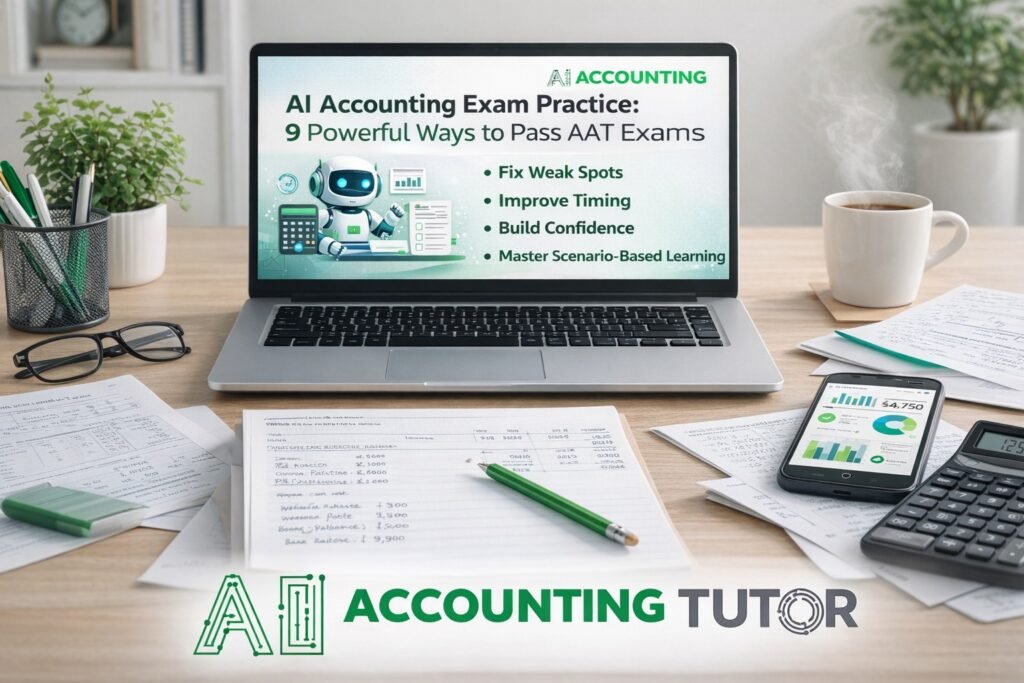
AI accounting exam practice is becoming one of the most effective ways for AAT students to prepare in 2026. Not because it replaces hard work, and not because it gives shortcuts, but because it changes how practice actually works.
Most students don’t fail because they’re incapable. They struggle because their revision lacks structure, feedback, and repetition under pressure. AI accounting exam practice fixes that. It turns passive revision into active decision making, and that’s where confidence is built.
If you’re studying AAT and want to feel calm walking into the exam room rather than hoping for the best, here’s how AI accounting exam practice makes the difference.
Traditional revision often focuses on isolated questions. Exam practice builds full business scenarios instead.
You’re not just calculating depreciation. You’re reviewing fixed asset registers for a growing company. You’re not just posting journals. You’re correcting errors in a trial balance under time pressure.
This mirrors how accounting works in real life and how AAT exams are structured.
For official qualification details, you can review the current standards directly via the Association of Accounting Technicians.
One of the biggest advantages is immediate diagnostic feedback.
Instead of marking your paper days later, AI highlights:
That instant correction loop helps prevent repeated errors becoming habits.
For broader context on how artificial intelligence supports adaptive learning, IBM provides insight into how AI models analyse patterns and personalise feedback across industries.
AAT exams are as much about timing as knowledge.
AI accounting exam practice allows you to:
Practising under timed conditions repeatedly removes the shock factor on exam day.
There’s a difference between memorising formats and understanding logic.
AI accounting exam practice pushes you to explain:
When you’re asked to justify answers, you stop guessing and start reasoning like an accountant.
AAT content can feel heavy at first. Large topics such as double entry, VAT, accruals and adjustments can blur together.
AI accounting exam practice breaks topics into:
This structured approach keeps revision manageable and consistent.
Repetition is powerful when it’s intelligent.
AI accounting exam practice rotates question types, restructures wording, and slightly changes figures. This forces genuine understanding rather than memorised pattern recognition.
That means when the exam question looks different from your revision example, you’re still comfortable.
Exam wording can be tricky. Students often know the concept but misread the question.
AI accounting exam practice exposes you to varied phrasing, so you learn to decode:
Understanding language nuance is a quiet but critical exam skill.
Not everyone has daily tutor access.
AI accounting exam practice gives you structured support whenever you need it. Whether that’s late evening revision or quick topic refreshers before work, the feedback is always available.
For insight into how AI is reshaping digital education globally, organisations such as UNESCO regularly publish research on AI in learning environments.
The biggest benefit of AI accounting exam practice is psychological.
When you’ve:
You walk into the exam knowing you’ve done the work properly.
Confidence is not bravado. It’s familiarity.
And AI accounting exam practice creates that familiarity at scale.
Accounting education is evolving. Employers expect more than memorised theory. They want structured thinking, problem solving, and digital fluency.
AI accounting exam practice develops all three.
Used properly, it doesn’t replace tutors or textbooks. It enhances them. It fills the gaps between lessons. It reinforces logic. It accelerates learning cycles.
And in 2026, that edge matters.
If you’re studying AAT right now, the goal isn’t just passing the exam. It’s becoming comfortable with accounting logic.
AI accounting exam practice helps you rehearse decisions, refine accuracy, and reduce exam anxiety through repetition and structure.
Global research from UNESCO highlights how artificial intelligence is transforming personalised learning and adaptive assessment.
The more you practise with feedback, the more natural accounting becomes.
And when it feels natural, passing becomes a by-product.
Enjoyed this? Check out our other blogs here
Support Team
I will be back soon


