Share this post:

AI accounting is already changing how modern accounting works, often quietly and without much noise. Not through dramatic job losses or overnight disruption, but through better tools, smarter systems, and fewer manual tasks pulling accountants away from meaningful work.
From automated bookkeeping to predictive cash flow insights, AI is becoming part of everyday accounting practice. Whether you’re studying accounting, running a firm, or managing business finances, understanding how AI accounting tools actually work is now a practical skill, not a future idea.
And this shift is only accelerating.
Despite the headlines, AI isn’t replacing accountants. It’s changing how good accounting is done. Faster. Cleaner. More insight-led. And far less manual.
If you’re studying accounting, running a practice, or managing your own finances, understanding how AI fits into modern accounting is no longer optional. It’s foundational.
Let’s break down what’s actually happening.
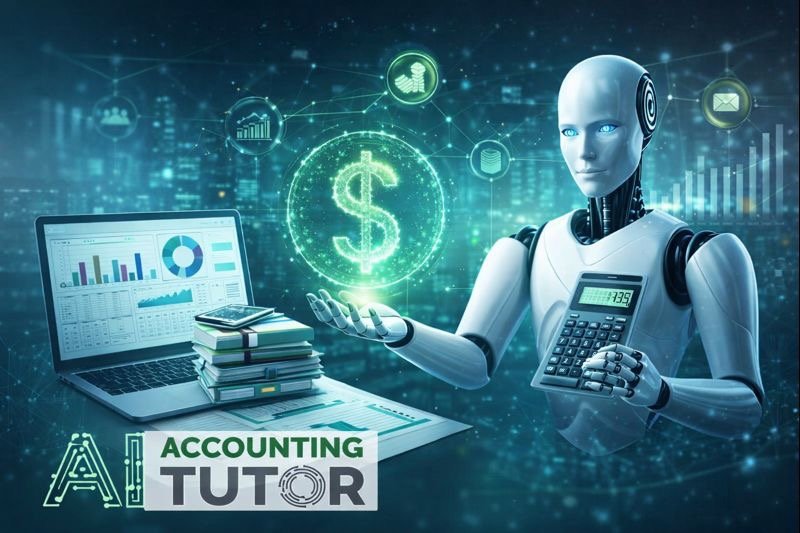
What Do We Really Mean by “AI in Accounting”?
AI in accounting isn’t one thing. It’s a collection of tools and systems that can:
• read and categorise data
• recognise patterns
• learn from historical information
• automate repetitive decisions
• flag issues before humans notice them
Most modern accounting software already uses AI in the background. You might not even notice it working.
And that’s the point.
Traditional bookkeeping relies heavily on rules. AI-driven bookkeeping goes a step further.
Modern systems learn from previous transactions, supplier behaviour, and categorisation patterns. Over time, the software becomes more accurate, reducing manual corrections and saving hours each month.
This doesn’t remove the need for bookkeepers. It removes the need for repetitive data entry.
Human time gets redirected towards review, interpretation, and problem-solving. That’s where real value sits.
Invoice capture used to be painfully manual.
AI now reads invoices, extracts data, validates totals, checks VAT treatment, and flags anomalies automatically.
Expense claims are treated the same way. Receipts are scanned, categorised, and matched with policies in seconds.
For businesses, this means:
• faster processing
• fewer errors
• clearer audit trails
For accountants, it means less chasing paperwork and more control.
One of AI’s most useful accounting applications is cash flow prediction.
By analysing historical income, spending patterns, seasonal trends, and payment behaviours, AI tools can forecast cash flow issues before they appear.
This shifts accounting from reactive to proactive.
Instead of explaining what already went wrong, accountants can warn clients early and help them make better decisions ahead of time.
That’s a fundamental change in how accounting supports businesses.
Compliance is where AI quietly shines.
AI systems can:
• spot unusual transactions
• highlight inconsistencies
• flag missing documentation
• identify potential tax issues early
This is especially useful when dealing with bodies like HMRC, where accuracy and consistency matter far more than speed alone.
AI doesn’t replace professional judgement. It acts like a second set of eyes that never gets tired.
Financial reports don’t need to be complicated to be powerful.
AI-driven reporting tools can:
• summarise large data sets
• visualise trends clearly
• explain changes in plain language
• surface insights automatically
This makes financial information more accessible to business owners who don’t live inside spreadsheets.
Good accountants already do this manually. AI simply speeds up the process and reduces friction.
AI is changing what accountants do, not whether they’re needed.
The most valuable skills going forward are:
• interpretation
• communication
• judgement
• ethical reasoning
• strategic thinking
Routine processing is being automated. Insight and trust are becoming the differentiators.
For students and career changers, learning accounting alongside AI tools is a serious advantage, not a threat.
Understanding AI in accounting isn’t about becoming technical or learning to code.
It’s about knowing:
• what AI can do well
• where human judgement is essential
• how modern tools fit into real-world accounting
That’s exactly where AI Accounting Tutor focuses.
Not hype. Not fear. Just practical understanding of how accounting actually works today.
AI accounting isn’t rewriting accounting overnight.
It’s quietly removing friction.
Reducing repetition.
Improving accuracy.
And giving accountants more space to think.
Those who understand it early gain confidence.
Those who ignore it eventually feel left behind.
Accounting has always rewarded adaptability.
AI accounting simply raises the bar.
Want to read more? Check out our other blog posts
Learn more about this subject with our Revolutionising Finance and Accounting with AI blog.
Support Team
I will be back soon


