Share this post:

 Type “is the AAT qualification worth it” into Google or ChatGPT and you’ll find thousands of people asking the same thing, usually at the same moment: about to spend money and a year of evenings on study, and wanting to know it leads somewhere. It’s the right question to ask before you enrol anywhere, and it deserves a straight answer rather than a sales page.
At AI Accounting Tutor, we support AAT students at every level, which means we also see who thrives, who struggles, and who probably picked the wrong route entirely. So here’s the honest version: what the AAT qualification actually is, what it costs in money and time, what it unlocks, how it compares to a degree, and, because no qualification is right for everyone, who shouldn’t do it.
The AAT qualification is the UK’s most widely held accounting qualification, awarded by the Association of Accounting Technicians, the professional body for accounting technicians. It’s practical rather than academic: instead of writing essays about accounting theory, you learn to do the work, bookkeeping, costing, preparing accounts, and you’re assessed through computer based exams that test exactly those skills.
Three features define it. It requires no degree and no prior experience to start. It’s studied flexibly, online or in the classroom, around jobs and families. And it’s recognised by employers across the UK as proof you can do the job, which is ultimately what any qualification is for. Hundreds of thousands of people hold it, from accounts assistants in small firms to finance professionals who used it as the first rung towards chartered status.
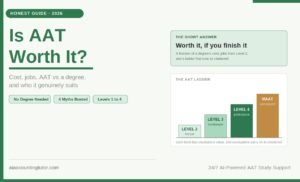
| Level | What it covers | Typical study time |
|---|---|---|
| Level 1 Award (optional) | A gentle introduction to bookkeeping basics, for those who want a taster first | A few weeks to a few months |
| Level 2 Certificate | The foundations: double entry bookkeeping, costing, the business environment. Where most people start | 6 to 12 months part time |
| Level 3 Diploma | Deeper skills: final accounts, management accounting techniques, tax processes | 6 to 12 months part time |
| Level 4 Diploma | Professional level: drafting financial statements, management accounting, specialist options | 9 to 15 months part time |
After Level 4, with some practical experience, you can apply for full AAT membership and use the letters MAAT, a recognised professional status in its own right. The AAT qualification also earns exemptions towards chartered bodies like ACCA, CIMA and ICAEW if you want to keep climbing, which makes it a genuine stepping stone rather than a dead end.
First, a practical point that surprises many prospective students: AAT exams are on demand. There are no fixed exam seasons; you book each computer based assessment individually, when you’re ready, at an approved venue. That changes the whole rhythm of study. You’re never cramming for a distant exam week, you’re working steadily towards the next single unit, sitting it, and moving on. For adults juggling work and family, that flexibility is one of the AAT qualification’s most underrated features, and it also means a strong student can move faster than any fixed timetable would allow.
Costs vary by provider and level, but the shape is consistent: course fees typically run from a few hundred pounds per level with online providers, plus AAT’s own registration fee per qualification and an assessment fee for each exam you sit, usually a hundred pounds and something per unit. Because AAT exams are computer based and booked individually, you pay per sitting rather than in one lump, which spreads the cost naturally across your study. All in, completing Levels 2 to 4 usually costs a low four-figure sum spread over two to three years. Compare that with the tens of thousands a degree now costs and the difference is stark, which is exactly why the AAT qualification has become the default route for career changers.
Two cost tips worth knowing before you enrol anywhere. Ask any provider for the full journey price, tuition, materials, and whether exam sittings are included or extra, because headline fees don’t always compare like for like. And if you’re claiming Universal Credit or Jobseeker’s Allowance, ask your Jobcentre work coach whether funding support is available for accounting training, because for some students the course cost disappears entirely.
The time cost is the honest part most guides skip. Studied part time, each level is 6 to 12 months of consistent effort, roughly 45 to 60 minutes most days. The people who find the AAT qualification worth it are almost always the people who actually finish it, and finishing is a consistency problem more than an intelligence problem. Budget the hours as seriously as the fees.
From Level 2, you’re credible for junior finance roles: accounts assistant, finance assistant, bookkeeping assistant, purchase and sales ledger roles. Level 3 opens assistant accountant and bookkeeper positions with real responsibility, and many self-employed bookkeepers build practices on it. Level 4 and MAAT status support roles like assistant management accountant, payroll manager, and finance officer, and licensed AAT members can run their own accounting practices offering services to the public.
Two features of this market matter for the worth-it question. Demand is broad and stable, because every organisation in every sector needs its finances managed, in good years and bad. And progression is visible: it’s normal to land a junior role while studying Level 2 or 3, then let an employer fund the rest, meaning the AAT qualification often starts paying for itself before you’ve finished it. On pay, AAT publishes its own salary survey if you want figures, but the honest summary is that qualified members typically out-earn unqualified colleagues doing similar work, and the gap widens with each level.
When people ask whether the AAT qualification is worth it, they’re often really asking: should I do this or a degree? It’s a fair question, because for decades the degree was the assumed answer, and assumptions outlive the conditions that created them. With tuition fees where they are and employers increasingly hiring on demonstrable skills, the comparison now comes down to what you’re optimising for.
For someone who knows they want a finance career, wants to earn while they learn, and doesn’t fancy the debt, the AAT qualification wins this comparison comfortably. For an 18 year old who might yet become a lawyer, it’s a genuine choice.
One path deserves its own mention, because for it the worth-it question has an unusually clear answer. If your ambition is working for yourself, doing bookkeeping or accounts for local businesses around your own schedule, the AAT qualification is effectively the entry ticket. AAT offers a licensed membership route that allows members to provide services to the public legitimately, with the professional body’s name behind them, and clients and referral sources recognise it.
The economics are attractive too: training costs in the hundreds or low thousands, and a self-employed bookkeeper with a modest client list can recover that within months of starting. For parents wanting school-hours work, career changers wanting independence, and anyone building a side income towards a full practice, this is the route with the shortest distance between qualification and invoice. It’s a large part of why the AAT qualification keeps growing while traditional routes stagnate.
For the right person, yes, and by a wide margin. Judged as an investment, the AAT qualification is one of the strongest in UK education: modest cost, no debt, study that fits around life, a job market that never empties, professional letters after your name, and a ladder that runs all the way to chartered if you want it. The people for whom it disappoints are almost always mismatched with the work or never finished, which is why the honest version of “is it worth it” is really “is it right for me, and will I complete it”. If both answers are yes, it’s difficult to name a better-value route into a profession.
Put it one final way. A year from now you’ll be a year older regardless. The AAT qualification offers a version of that year where the evenings you’d have spent anyway convert into a credential, a new job market, and a profession with a ladder in it. Very few uses of a spare hour a day compound like that, and that, more than any rate of pay or exam pass, is the real answer to whether it’s worth it.
Since finishing is where the value lives, stack the odds. Study little and often rather than in weekend marathons. Nail the foundations early, especially double entry, which underpins every level (our guide to double entry bookkeeping is the place to start). Practise questions from day one and sit timed mocks before every exam, the full method is in our guide to passing AAT exams first time. And never let a confusing topic sit unresolved for a week, because stalled momentum is how AAT journeys quietly end.
That last point is exactly why the AI Accounting Tutor exists: a study companion for AAT students, for £9.99 a month, that explains any topic in plain English, step by step, at any hour, and generates practice until concepts feel natural. It works alongside whichever course provider you choose, and it’s the difference between getting stuck on a Tuesday night and getting unstuck on the same Tuesday night. You can start today for less than the cost of a takeaway.
For most people who want a finance career without a degree, yes. It costs a fraction of university, fits around work and family, unlocks junior finance roles from Level 2 onwards, and leads to professional MAAT status and chartered exemptions. Its value depends on finishing, so consistency matters more than anything.
Yes. AAT is the UK’s leading professional body for accounting technicians, and the qualification is widely recognised by employers as evidence of practical, job-ready accounting skills. Licensed AAT members can also run their own practices.
Yes. Level 2 supports applications for roles like accounts assistant, finance assistant and bookkeeping assistant, and many students land their first finance job while still studying, then progress to Level 3 with their employer’s support.
Studied part time, each level typically takes 6 to 12 months, with Level 4 sometimes a little longer. Completing Levels 2 to 4 commonly takes two to three years from a standing start, faster with intensive study.
For someone committed to a finance career, AAT is usually faster, far cheaper, and gets you earning sooner, and combined with chartered study it reaches the same senior roles. A degree’s advantage is breadth if you’re not yet sure accounting is your path.
MAAT stands for full membership of the Association of Accounting Technicians, available after completing the qualification and demonstrating practical experience. It’s a recognised professional status, and the letters appear after your name.
Yes. Completing AAT earns exemptions towards chartered bodies including ACCA, CIMA and ICAEW, which makes it a common first stage on the route to becoming a chartered accountant.
Consistent short study sessions, early mastery of double entry, regular practice questions and timed mocks, and getting stuck concepts explained immediately. The AI Accounting Tutor provides that last part 24/7 for £9.99 a month, working alongside any AAT course provider.
Support Team
I will be back soon


