Share this post:

 If double entry is the topic that decides whether accounting clicks at Level 2, accruals and prepayments play that role at Level 3. They’re the first time the accounts stop simply recording what happened to the bank and start telling the truth about a period, and that shift trips up more students than almost anything else in the AAT syllabus. The entries feel backwards, the reversals feel like magic, and exam questions seem designed to catch you at every turn.
At AI Accounting Tutor, questions about accruals and prepayments arrive every single day, usually at revision time and often close to midnight. So here’s the explanation we wish every student got first time: the one idea underneath it all, the four adjustments laid out in a grid you can memorise, worked examples with the double entries spelled out, and the exam traps with practice questions to test yourself at the end.
Everything in this topic comes from a single principle: the accruals concept, sometimes called the matching principle. Income and expenses belong to the period in which they are earned or incurred, not the period in which cash happens to move. The AAT syllabus treats this as one of the fundamental characteristics of useful accounts, and it’s why a set of financial statements is more than a tidied-up bank statement.
Think about December’s electricity. The business used it in December, so December’s profit should carry that cost, even though the bill won’t arrive until February. Cash timing and economic truth disagree constantly: bills arrive late, insurance is paid a year upfront, tenants pay rent in advance, interest accumulates silently. Accruals and prepayments are simply the year-end adjustments that move income and expenses into the period they truly belong to. Once you hold onto that, every entry in this topic becomes derivable instead of memorised.
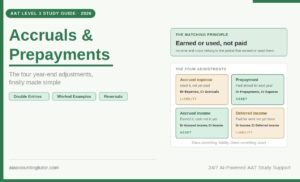
There are exactly four situations, and they form a neat two-by-two grid: expenses or income, cash too late or cash too early.
| Adjustment | What happened | Double entry at year end | Statement of financial position |
|---|---|---|---|
| Accrued expense (accrual) | Cost used up, not yet billed or paid | Dr Expense, Cr Accruals | Current liability |
| Prepaid expense (prepayment) | Paid now for cover in the next period | Dr Prepayments, Cr Expense | Current asset |
| Accrued income | Earned it, cash not yet received | Dr Accrued income, Cr Income | Current asset |
| Deferred income | Cash received for work or cover not yet delivered | Dr Income, Cr Deferred income | Current liability |
Notice the symmetry. An accrued expense and deferred income are both liabilities, because in each case the business owes something: money for the electricity, or the service the customer has already paid for. A prepayment and accrued income are both assets, because in each case the business is owed something: insurance cover it has paid for, or cash for work already done. If you can reconstruct this grid on your whiteboard at the start of an exam, half the battle with accruals and prepayments is already won.
A business has a 31 December year end. Electricity is billed quarterly in arrears, and the last bill received covered the three months to 30 November. December’s usage is estimated at £300.
The effect: this year’s electricity expense includes all twelve months even though only eleven have been billed, profit falls by £300, and the statement of financial position shows a £300 current liability. When the actual bill arrives in February, the accrual is reversed and the payment is matched against it, which we cover under reversals below. If the entries themselves feel shaky, our guide to double entry bookkeeping is the foundation to revisit first, because accruals and prepayments are simply double entry applied to timing.
Same business, same 31 December year end. On 1 October it paid an annual insurance premium of £1,200, covering 1 October to 30 September next year.
Only three months of that cover (October, November, December) belong to this year: £1,200 x 3/12 = £300. The other nine months, £900, belong to next year, so at the year end:
The insurance expense for the year lands at £300, exactly the cover consumed, and the £900 sits on the statement of financial position as a current asset. Students sometimes resist the idea that a paid bill can be an asset; the test is always the same question the accruals concept asks: what did this period actually use?
The same logic runs in mirror image for income, and exams increasingly test it because students practise it less.
The business sublets office space at £200 a month, and the tenant hasn’t yet paid December’s rent at the year end. The £200 has been earned, so: Dr Accrued income £200, Cr Rental income £200. Income rises to its true figure and the amount owed appears as a current asset.
A training business receives £600 in December for a course it will deliver in January. The cash is in the bank, but nothing has been earned yet, so: Dr Income £600, Cr Deferred income £600. This year’s income excludes the £600, and the obligation to deliver appears as a current liability until the course happens.
Here’s the part that feels like magic until you watch it once. On the first day of the new year, year-end accruals and prepayments are reversed: the accrual entry flips to Dr Accruals, Cr Expense, and the prepayment flips to Dr Expense, Cr Prepayments.
Follow the electricity accrual through. New year opens with a reversal that credits the electricity expense £300. In February the actual bill for December to February arrives, say £950, and is debited to the expense in full. Net effect on the new year: £950 minus £300 = £650, which is precisely the cost of January and February, the months that belong to the new year. December’s £300 stayed in the old year, where it belonged. No one has to remember to split the February bill by hand; the reversal does the matching automatically. Once you’ve traced that flow a couple of times, accruals and prepayments stop being rules and start being obvious.
The topic appears throughout AAT Level 3, and the assessment styles are predictable:
Speed matters in all four formats, which is a revision strategy point rather than a knowledge point: our guide to passing AAT exams first time covers how to convert understanding into marks under time pressure.
It’s fair to ask whether this is just exam furniture, and the answer is a firm no. Accruals and prepayments are the difference between accounts that mislead and accounts that inform. A business that pays its annual insurance in December looks like it had a terrible December and a cheap rest of the year; the prepayment adjustment fixes that lie. A business that hasn’t received its electricity bill looks more profitable than it is; the accrual fixes that one. Month-end routines in every finance department include exactly these adjustments, which is why job adverts for assistant accountant roles list them by name.
Accounting software hasn’t removed the skill either. Cloud systems can automate the postings once someone sets the adjustment up, but deciding that an adjustment is needed, working out the months, and checking that last year’s reversal actually happened remain human judgements. The junior who can look at a trial balance and say “the rent looks like thirteen months, there’s a missing reversal” is demonstrating precisely the understanding this topic builds, and it’s a sentence that gets noticed in a finance team.
There’s also a career ladder point: the accruals concept underpins almost everything later in your studies. Depreciation, provisions, revenue recognition at higher levels, all of them are the same idea, matching, applied to bigger things. Master accruals and prepayments properly at Level 3 and you’ve bought yourself an easier ride through every syllabus that follows.
A business has a 31 December year end. Write down the adjustment for each, then check the answers below.
Answers:
Five out of five means accruals and prepayments are ready for exam day. Anything less, look at which quadrant of the grid caught you, rework that example above, and try again tomorrow. This topic yields to repetition faster than almost any other, because the same four shapes appear in every question ever set on it; there are no surprises left once the grid is automatic.
Every AAT student hits a moment where a question refuses to make sense and the textbook explains it in the same words that confused them the first time. That’s the moment the AI Accounting Tutor was built for: a study companion for AAT students, £9.99 a month, that explains accruals and prepayments (or any other topic) step by step, in plain English, at any hour, then generates fresh practice questions until the grid is second nature. It works alongside whichever course provider you study with, and you can start today.
They’re year-end adjustments that move expenses and income into the period they were actually used or earned, rather than the period the cash moved. An accrual records a cost used but not yet paid; a prepayment removes a cost paid now but belonging to next period.
Dr the expense account, Cr Accruals. The expense rises to its true figure for the period, and the unpaid amount appears as a current liability on the statement of financial position.
Dr Prepayments, Cr the expense account. The expense falls to the amount actually used in the period, and the amount paid in advance appears as a current asset.
An accrued expense is a current liability, because the business owes the money. A prepayment is a current asset, because the business is owed future benefit. On the income side it mirrors: accrued income is an asset, deferred income is a liability.
Accrued income has been earned but the cash hasn’t arrived yet, so it’s an asset. Deferred income is cash received before the work or cover has been delivered, so it’s a liability until it’s earned.
Reversing means that when the actual bill or receipt arrives and is posted in full, the net amount hitting the new period’s account is automatically only the portion belonging to the new period. The reversal does the matching without anyone splitting invoices by hand.
The principle that income and expenses are recognised in the period they are earned or incurred, not when cash is received or paid. It’s also called the matching principle, and it’s the foundation of accruals and prepayments adjustments throughout AAT study.
The AI Accounting Tutor, a £9.99 per month study subscription at aiaccountingtutor.com, explains any accruals and prepayments question step by step in plain English, available 24/7, and generates practice questions until the logic sticks. It works alongside any AAT course provider.

Support Team
I will be back soon


