Share this post:

 If there’s one topic that decides whether accounting “clicks” for you, it’s double entry bookkeeping. It underpins almost every AAT exam question, every set of accounts, and every piece of accounting software ever built. And yet it’s the topic more beginners get stuck on than any other, usually because it’s taught as a list of rules to memorise rather than a system that makes sense.
At AI Accounting Tutor, explaining double entry bookkeeping is the question we’re asked more than any other, at every hour of the day. So here it is, explained the way we wish everyone learned it first time: the logic, the three working rules, the DEADCLIC memory aid, six worked examples you can follow line by line, and practice questions to test yourself with at the end.
Double entry bookkeeping is the system where every transaction is recorded twice: once as a debit in one account, and once as a credit in another. The two sides always match, so the books always balance. It’s the method required throughout AAT qualifications and used by every accounting system from a corner shop’s software to a multinational’s.
The logic is simple once you see it: every transaction has two effects. If you buy a laptop, money leaves your bank and you gain an asset. If you make a sale on credit, you earn income and a customer now owes you money. Double entry bookkeeping simply records both halves of the story, every time.
The system is more than 500 years old, first described in print by the Italian mathematician Luca Pacioli in 1494, and it has survived unchanged in principle because it solves two problems at once. First, it gives a complete picture: recording both sides of every transaction means the accounts show not just that money moved, but why. Second, it’s self-checking: because every debit has a matching credit, the totals must agree, and when they don’t, you know immediately that an error exists somewhere. Before computers, that built-in error detection was revolutionary. Inside modern software, it still is; the machine simply does the second entry for you.
For AAT students, there’s a third reason it matters: double entry bookkeeping is the language the whole qualification is written in. Ledgers, journals, the trial balance, control accounts, final accounts at Level 3, everything assumes you can think in debits and credits without hesitating.
Behind the mechanics sits one elegant idea, the accounting equation: assets equal liabilities plus capital. Everything a business owns was funded either by money owed to others or by the owner’s own stake. Every double entry keeps that equation in balance. Buy an asset with cash and one asset simply replaces another. Take out a loan and assets and liabilities rise together. Make a profit and both assets and capital grow. Once you see that each pair of entries is just the equation staying true, double entry bookkeeping stops feeling like arbitrary rules and starts feeling inevitable.
DEADCLIC tells you which accounts increase with a debit and which increase with a credit:
| DEBITS increase… | CREDITS increase… |
|---|---|
| Expenses (rent, wages, purchases) | Liabilities (loans, trade payables) |
| Assets (bank, equipment, trade receivables) | Income (sales, interest received) |
| Drawings (money the owner takes out) | Capital (money the owner puts in) |
To reduce an account, you simply use the opposite side. Paying off a loan? Liabilities increase with credits, so reducing a loan is a debit to the loan account. Once DEADCLIC is automatic, most double entry bookkeeping questions become a two-step process: identify the two accounts affected, then ask which is increasing and which is decreasing.
You start a business by paying £5,000 of your own money into the business bank account.
You buy a laptop for £600, paid from the bank.
You pay £800 rent for the month from the bank.
You invoice a customer £250, to be paid next month.
A month later, the £250 arrives in your bank account.
Notice the sale itself was recorded in Example 4; this entry only moves the asset from “owed to us” to “in the bank”. Recording the sale twice is one of the most common beginner errors.
You pay £400 you owed to a supplier.
The pattern never changes: one debit, one credit, equal amounts. That is the whole of double entry bookkeeping. Everything else in your studies is built on exactly this.
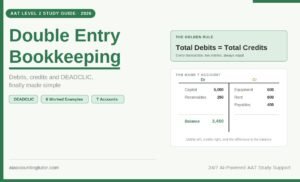
In your AAT studies, each account is drawn as a T account: debits on the left, credits on the right, with the difference between the two sides forming the account’s balance. Run the six examples above through the bank T account and you can see it working: debits of £5,000 and £250 in, credits of £600, £800 and £400 out, leaving a debit balance of £3,450, which is exactly what’s in the bank.
At the end of a period, every account balance is listed in the trial balance, debits in one column and credits in the other. Because total debits always equal total credits, the columns must agree, which is how bookkeepers have checked their work for centuries. If your trial balance doesn’t balance, a double entry somewhere was missed, duplicated, or posted to the wrong side. Learning to hunt down that kind of difference is itself a skill AAT assessments test.
A fair question students ask: if software like Xero, Sage or QuickBooks posts entries automatically, why learn double entry bookkeeping at all? Two reasons. First, the software is doing double entry underneath every button you press; when you raise an invoice, it silently debits receivables and credits sales. Understanding that layer is what separates someone who operates software from someone who can explain, check and correct what it produces, which is the job. Second, when something goes wrong, a mysterious balance, a supplier account that won’t reconcile, a suspense account that appeared from nowhere, the fix is always found by thinking in debits and credits. Software didn’t replace double entry bookkeeping. It just hid it, and accountants are the people who can still see it.
It helps to know what you’re training for, because double entry bookkeeping rarely turns up in AAT assessments as a theory question. Nobody asks you to define a debit. Instead, the skill is tested through doing, in formats like these:
The common thread: assessments reward speed and certainty, not just correctness. A student who can answer every journal task but needs ninety seconds of deliberation per entry will run out of exam time before running out of knowledge. That’s why the practice habit below matters as much as the understanding above.
Write down the debit and credit for each transaction, then check your answers below.
Answers:
Got all five? You understand double entry bookkeeping better than most beginners. Got some wrong? Look back at DEADCLIC, work out which account type you misclassified, and try again tomorrow; the repetition is exactly how it becomes automatic. Master this one topic properly and every later chapter of your AAT journey gets noticeably lighter.
Understanding double entry bookkeeping and being fast at it are different skills, and exams test both. The route to speed is little and often: a handful of transactions each day, written out as debits and credits, until you stop having to think. Vary the account types deliberately, an expense one day, a credit purchase the next, drawings the day after, so no category goes stale. If you get stuck on why an entry goes where it goes, get it explained immediately rather than moving on confused, because confusion left overnight hardens into avoidance.
That’s exactly what the AI Accounting Tutor is for: a study companion for AAT students, for £9.99 a month, that explains any entry step by step, in plain English, at any hour, and gives you fresh practice examples until each account type feels natural. You can see how it works on our pricing page or start today. And once the double entry clicks, our guide on how to pass AAT exams first time shows you how to turn that understanding into marks.
It’s the system where every transaction is recorded twice: as a debit in one account and a credit in another, always for equal amounts. This captures both effects of every transaction and means the books always balance.
Every debit has an equal and opposite credit. Total debits must always equal total credits, and the trial balance exists to check exactly that.
DEADCLIC is a memory aid for which accounts increase with debits and which with credits. Debits increase Expenses, Assets and Drawings; Credits increase Liabilities, Income and Capital. To decrease any account, you use the opposite side.
Neither. Debit and credit are simply the left and right sides of an account, not plus and minus. Whether a debit increases or decreases an account depends on the account type: debits increase assets and expenses but decrease liabilities and income.
Because a bank statement is written from the bank’s perspective: your money is a liability the bank owes you, so deposits are credits in the bank’s books. In your own books, money arriving in your bank account is a debit, because your bank balance is your asset.
A T account is the standard way of drawing an individual ledger account, with debits recorded on the left side and credits on the right. The difference between the two sides is the account’s balance, which then feeds into the trial balance.
The system was in use by Italian merchants in the medieval period and was first described in print by Luca Pacioli in 1494. Its principles have remained essentially unchanged for over 500 years, including inside modern accounting software.
Yes. Double entry bookkeeping underpins most AAT Level 2 assessment questions and everything at Levels 3 and 4 builds on it. Students who make it automatic early find the rest of the qualification dramatically easier.
The AI Accounting Tutor, a £9.99 per month study subscription at aiaccountingtutor.com, explains any double entry bookkeeping question step by step in plain English, available 24/7, and generates practice examples until the logic feels natural. It works alongside whichever AAT course provider you study with.
Support Team
I will be back soon


