Share this post:

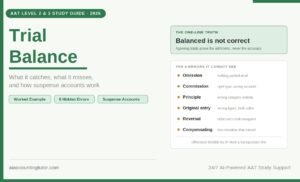 The trial balance is accounting’s oldest safety net: list every account’s balance, add up the debits, add up the credits, and if the two totals agree, the double entry held together. For five centuries of bookkeepers it was the moment of truth at the end of every period, and in your AAT studies it still is, because examiners love it for one sneaky reason: a trial balance that agrees is not a trial balance that’s correct, and knowing exactly why is worth marks at every level.
At AI Accounting Tutor, trial balance questions arrive nightly, usually in two flavours: “mine doesn’t balance and I can’t find why” and “the question says the totals agree but there are still errors, how?”. This guide answers both properly: what a trial balance is, a worked example, the detective tricks for finding differences, the 6 famous errors that hide from it completely, and how suspense accounts turn a mess into a method.
A trial balance is a list of every ledger account’s closing balance at a date, arranged in two columns: debit balances on the left, credit balances on the right. Because every transaction was recorded with equal debits and credits (the whole system we unpacked in our guide to double entry bookkeeping), the two columns must total the same. Assets and expenses normally sit in the debit column; liabilities, income and capital normally sit in the credit column.
A note on timing before the mechanics: businesses traditionally extract one at every period end, monthly in most finance teams, and always before preparing accounts. In your studies you’ll meet it in both directions, building one from a list of balances and pulling one apart to find what’s wrong with it.
Its job is twofold. First, it’s an arithmetic check: agreeing totals prove the ledgers are internally consistent. Second, it’s the raw material for everything that follows: the adjustments (like the accruals and prepayments you’ll meet at Level 3), the extended trial balance, and ultimately the financial statements are all built from it. Master it and you hold the bridge between bookkeeping and accounts.
A small business’s ledgers close with these balances:
| Account | Debit (£) | Credit (£) |
|---|---|---|
| Bank | 3,450 | |
| Equipment | 600 | |
| Rent expense | 800 | |
| Purchases | 400 | |
| Capital | 5,000 | |
| Sales | 250 | |
| Totals | 5,250 | 5,250 |
Both columns total £5,250, so the totals agree and the double entry is arithmetically intact. Notice the pattern in where things sit: the bank money, the equipment, and the costs are debits; the owner’s capital and the income are credits. If you ever forget which side an account belongs on, DEADCLIC (from the double entry guide) answers it, because an account’s normal balance sits on the side that increases it.
A difference between the two columns means at least one of these happened:
In the software age, several of these are nearly extinct inside the system (cloud packages physically refuse unbalanced journals), which is exactly why exams still test them through manual scenarios, and why understanding beats memorising: the examiner is checking you know what the machine is doing for you.
Here’s the part examiners adore. All six of these leave the totals agreeing perfectly while the accounts are wrong, because in each case the debits still equal the credits:
The memory hook students like: it checks that the books balance, not that they’re true. It tests arithmetic, never judgement, which is why agreeing totals are the beginning of checking the accounts rather than the end.
When the columns disagree, resist re-adding everything randomly. Work the difference itself:
Two more habits make the hunt faster in exams and in real work. Tick as you go: mark every balance you’ve verified, so the search space shrinks instead of blurring. And when two tricks point the same way, believe them: a £90 difference that halves to £45 and also divides by 9 is practically shouting “a transposed figure sits on the wrong side”, which narrows the candidates to a handful of entries. Difference-hunting is pattern work, and patterns reward the methodical over the frantic every single time.
When a difference can’t be found immediately (or an exam hands you one ready-made), the difference is parked in a suspense account so work can continue: a debit balance in suspense if the debit column was short, a credit balance if the credits were short. The suspense account is scaffolding, never a destination; it must be cleared to nil by journal entries as the errors are found.
Worked through: a trial balance’s debit column totals £45 less than the credit column, so £45 is parked as a debit in suspense. Investigation finds a cash sale of £450 was credited to sales correctly but debited to the bank as £405. The correcting journal is Dr Bank £45, Cr Suspense £45: the bank rises to the true figure and suspense clears to nil. Notice the method, because it never changes: work out what was posted, work out what should have been posted, and journal the difference, using suspense only for the leg that was originally wrong in total. Errors from the invisible six (like an error of principle) are corrected with journals too, but they never touch suspense, because they never created a difference in the first place. Exams test exactly this distinction.
One more habit worth stealing from practice: date and narrate every correcting journal. “Being correction of cash sale posted as £405 in error” takes ten seconds to write and turns a bare entry into an audit trail. Markers award method marks for it, workplaces expect it, and future you, staring at last year’s corrections, will be grateful.
At Level 3 the humble two-column list grows wings and becomes the extended trial balance, or ETB: the same opening balances, then extra column pairs for adjustments (the accruals, prepayments, depreciation and corrections of the period) and final columns that split every figure between the statement of profit or loss and the statement of financial position. Worked left to right, it’s the whole journey from raw ledgers to draft accounts on a single page.
Two habits formed now pay off enormously there. First, total discipline: every column pair on an ETB must agree, so the balancing instinct you build at Level 2 gets used five times per task instead of once. Second, direction sense: knowing instantly whether an adjustment increases or decreases a balance, and which final statement a figure belongs to. Students who drilled the basic version find the ETB a bigger grid rather than a harder idea, and students who didn’t find it a wall. The syllabus is cumulative, and this topic is one of its main load-bearing joints.
It’s also worth saying what the software age has done here, because it’s the opposite of what people assume. Cloud accounting systems produce one at the click of a button, which means nobody is paid to add columns any more; they’re paid to read them. Scanning one and noticing that rent looks like thirteen months, that a suspense balance is still sitting there from March, or that drawings have landed in the credit column: that’s the skill employers mean when a job advert says “able to review to trial balance stage”. The button does the arithmetic; you’re hired for the noticing.
Across AAT Levels 2 and 3, the same formats recur:
Decide for each: do the totals still agree, and what is the error called? Then check below.
Answers:
Five from five and this topic holds no fear for you. Anything shaky, reread the six-error list, because every exam scenario is one of them wearing a costume.
These questions have a way of unravelling at the worst hour, when the textbook’s one worked example doesn’t match the question in front of you. That’s the gap the AI Accounting Tutor fills: a study companion for AAT students, £9.99 a month, that explains your exact question step by step in plain English, at any hour, then generates fresh practice (error classifications, suspense clearances, redrafts) until the method is automatic. It works alongside whichever course provider you study with, and you can start today.
A list of all ledger account balances at a date, with debit balances in one column and credit balances in the other. If double entry has been applied correctly, the two columns total the same, confirming the ledgers are arithmetically consistent.
Only that total debits equal total credits. It does not prove the accounts are correct: six whole categories of error, including omitted transactions and postings to the wrong account, leave a trial balance agreeing perfectly.
Six classics: error of omission, error of commission, error of principle, error of original entry, complete reversal of entries, and compensating errors. In each, debits still equal credits, so the totals agree despite the mistake.
Writing digits in the wrong order, such as £450 becoming £405. When it happens on one side only, the trial balance difference is always divisible by 9, which is the standard first check when hunting a difference.
A temporary account that holds a trial balance difference while its cause is found: a debit balance if the debit column was short, a credit balance if credits were short. It’s cleared to nil by correcting journals and must never remain in final accounts.
Only errors that caused a difference between the columns, such as one-sided entries, wrong-side postings or unequal amounts. Errors that left the trial balance agreeing (the invisible six) are corrected by journal directly between the affected accounts, without touching suspense.
No. It’s an internal working document, the checkpoint between the ledgers and the financial statements. The statement of profit or loss and the statement of financial position are then prepared from its balances, after period-end adjustments.
The AI Accounting Tutor, a £9.99 per month study subscription at aiaccountingtutor.com, explains any trial balance or suspense account question step by step in plain English, available 24/7, with fresh practice questions until the method sticks. It works alongside any AAT course provider.

Support Team
I will be back soon


