Share this post:

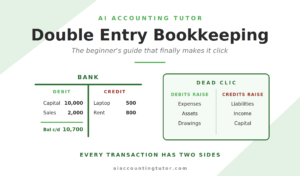 Double entry bookkeeping is the concept that decides whether accounting ever makes sense to you. Master it and everything that follows, from trial balances at Level 2 to full financial statements at Level 3, is just the same idea wearing bigger clothes. Fail to master it and every later topic feels like memorising rules that arrived from nowhere. Yet most explanations make it harder than it is, drowning a simple idea in jargon before showing you a single transaction.
This guide explains double entry bookkeeping the way it should be taught: one core idea, one memory aid, and worked examples you can follow line by line. By the end, debits and credits will be a tool you use, not a coin you flip.
Double entry bookkeeping rests on one observation: every transaction a business makes has two sides, because money never appears or disappears; it always comes from somewhere and goes somewhere. Buy a laptop for £500 cash and two things are true at once: the business owns a new asset (the laptop) and has £500 less cash. Double entry bookkeeping simply records both truths, every time.
That is the whole system. Every transaction is recorded twice, once as a debit in one account and once as a credit in another, and the two entries are always equal. Because every debit has a matching credit, the books must balance, and any imbalance signals an error. Everything else in accounting is machinery built on this single rule.
The mistake that breaks most beginners is treating debit as “minus” and credit as “plus” (or the reverse) because that is what bank statements taught them. In double entry bookkeeping, debits and credits are not good or bad, up or down. They are simply the left side and the right side of an account, and whether a debit increases or decreases the balance depends on what type of account it is:
The classic double entry bookkeeping memory aid is DEAD CLIC: Debits increase Expenses, Assets and Drawings; Credits increase Liabilities, Income and Capital. Write it at the top of your scrap paper in every practice session until you stop needing to. Every AAT student who “just gets” double entry bookkeeping is quietly running DEAD CLIC in their head.
Notice the logic rather than memorising blindly: assets and expenses are where money goes to (debit), while liabilities, income and capital are where money comes from (credit). A transaction takes value from a source and sends it to a destination, and the entries record both ends.
1. The owner puts £10,000 into the business bank account.
Money went to the bank (an asset): DEBIT Bank £10,000.
Money came from the owner (capital): CREDIT Capital £10,000.
The business gained an asset and simultaneously owes its existence to the owner. Both truths recorded.
2. The business buys a £500 laptop, paying cash.
Money went into a new asset: DEBIT Equipment £500.
Money came from the bank: CREDIT Bank £500.
Note the bank is credited even though a bank statement would show this as a debit. Your statement is written from the bank’s point of view, not the business’s, which is exactly why bank-statement intuition sabotages double entry bookkeeping.
3. The business invoices a customer £2,000 for services.
Value went to an amount now owed by the customer (an asset called receivables): DEBIT Receivables £2,000.
Value came from earning income: CREDIT Sales £2,000.
When the customer later pays: DEBIT Bank £2,000, CREDIT Receivables £2,000. The income was recorded when earned, not when paid, and the receivable simply converts into cash.
4. The business pays £800 rent (the double entry bookkeeping everyone gets right first).
Value went to an expense: DEBIT Rent £800.
Value came from the bank: CREDIT Bank £800.
Run any transaction through the same two questions, where did value go (debit) and where did it come from (credit), and double entry bookkeeping stops being a rulebook and becomes a reflex.
A T-account is double entry bookkeeping made visible: an account drawn as a T, the account name on top, debits on the left, credits on the right. Post the four examples above and the Bank T-account shows debits of £10,000 and £2,000 against credits of £500 and £800, leaving a debit balance of £10,700, which is exactly the cash the business should have. Balance off every account the same way, list all the closing balances, and you have a trial balance: total debits equal total credits, or something has gone wrong somewhere.
This is why double entry bookkeeping is self-checking, and why AAT builds the entire qualification on it. The trial balance you meet at Level 2 becomes the starting point for the financial statements you prepare at Level 3.
Nothing in AAT replaces double entry bookkeeping; each level simply builds more sophisticated double entry bookkeeping on the same base. Level 2’s Introduction to Bookkeeping establishes the entries themselves. Level 3’s financial accounting takes the same entries through accruals, prepayments, depreciation and irrecoverable debts to full statements, and it is precisely the students with shaky double entry foundations who hit the wall there (Level 3 pass rates are the lowest in the qualification). At Level 4 the mechanics are assumed entirely. An hour spent making double entry bookkeeping automatic at Level 2 repays itself at every level after.
A recording system where every transaction is entered twice, as a debit in one account and an equal credit in another, because every transaction has two sides: where value went and where it came from. Because the entries always match, the books must balance, making the system self-checking.
Use DEAD CLIC: Debits increase Expenses, Assets and Drawings; Credits increase Liabilities, Income and Capital. Write it down at the start of every practice session, and reinforce it with the logic: debits are where value goes, credits are where it comes from.
Your bank statement is written from the bank’s perspective: your balance is money the bank owes you, a liability in their books. In your business’s own books, the bank account is an asset, so money in is a debit. This single perspective shift fixes most beginner confusion.
The concept is genuinely simple: two questions per transaction. What takes time is making it automatic, which is a practice problem rather than an intelligence problem. Students who drill entries regularly find the rest of AAT dramatically easier than students who merely understood the chapter once.
Yes; it is the core of the Level 2 Certificate and the foundation of everything after it, through Level 3 financial statements to Level 4. It is the single highest-value topic to master early in the qualification.
Double entry bookkeeping is understood in an afternoon and mastered through repetition. The gap between those two states is where AAT marks are won and lost, because assessments test speed and reliability, not recognition.
AI Accounting Tutor closes that gap with unlimited practice entries and transactions at every difficulty, instant worked solutions showing both sides of every posting, and targeting that drills your reversals until they stop happening. Start your subscription and turn the foundation of the whole qualification into your strongest topic. And when you are ready to test yourself under exam conditions, our AAT exam booking guide and AAT exam day guide cover everything from booking to submit. For the official qualification structure, see the AAT website.

Support Team
I will be back soon


