Share this post:

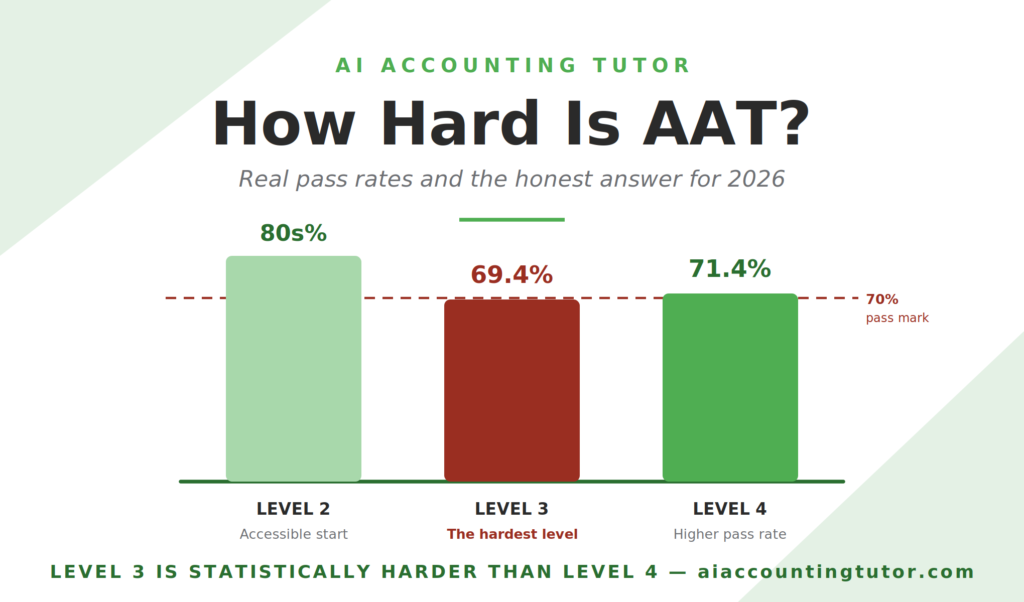
How hard is AAT really? Training providers have an incentive to say “very accessible” and exam-scarred students on forums have an incentive to say “brutal”, so the honest answer sits where it usually does: in the published numbers. AAT releases pass rates for its computer-based assessments, and they tell a clearer story than either sales pages or horror stories.
So how hard is AAT in short? It is genuinely accessible at Level 2, meaningfully demanding from Level 3 onwards, and roughly three in ten UK sittings at the higher levels end in a fail. It is not a qualification you can coast through, and it is absolutely not one that requires exceptional talent. This how hard is AAT guide gives the real pass rates, names the units students actually struggle with, and explains what separates the students who pass first time from the rest.
AAT’s most recent published statistics (covering the year to 31 December 2025) show global computer-based assessment pass rates of:
Read those Level 3 and 4 numbers again, because they contain the most useful answer to how hard is AAT in this entire article: Level 3 has a lower pass rate than Level 4. The “hardest” level of AAT, statistically, is not the top one. It is the middle one, and it has been for several consecutive reporting periods.
Why is this the how hard is AAT surprise? Level 3 is where the qualification’s difficulty steps up sharply: double-entry becomes full financial statements preparation, and costing becomes management accounting techniques. Students arrive from a gentle Level 2 with study habits that worked fine for foundations and collide with content that punishes them. By Level 4, the weaker-prepared students have either fixed their study approach or left, so the surviving cohort passes at a higher rate despite harder material.
The practical takeaway for anyone asking how hard is AAT: do not budget your effort by level number. Budget it by the step change at Level 3.
Averages hide the real answer to how hard is AAT. The latest UK figures identify the assessments with the lowest pass rates:
Notice the how hard is AAT pattern: the four hardest units are the two Level 3 core technical units and the Level 4 units heavy on either computation-at-speed or written explanation. If you want a precise answer to how hard is AAT for you personally, it is largely a question of how you will handle these four assessments.
Another piece of the how hard is AAT puzzle: every unit requires 70% to pass. That single number explains a great deal about how hard is AAT in practice, because 70% is an unforgiving threshold: you cannot write off a topic area and rely on strength elsewhere. A syllabus area you always skip in revision is typically 10 to 15 marks surrendered before you enter the exam room, and on a 70% pass mark that is most or all of your margin gone.
Grades add a second layer to how hard is AAT. The completed qualification is graded on your weighted average: Pass at 70 to 79%, Merit at 80 to 89%, Distinction at 90% and above. Distinctions are genuinely rare at the top level: in recent AAT figures only around 3% of Level 4 completers achieved one, with roughly half earning a Merit. If you are chasing a Distinction, you are chasing something only a small minority reach, and that context matters when you judge your own results.
Context changes the how hard is AAT answer. Against the qualifications people usually compare it with:
Ask students who failed a unit how hard is AAT and why, and the same causes repeat. The maths itself almost never features:
How hard is AAT for you specifically is largely within your control. The difference between the 63% who pass MATS and the 37% who do not is rarely intelligence. It is preparation style:
Whatever your answer to how hard is AAT turns out to be, a failed unit is recoverable by design: our AAT resit guide covers turning a fail into a first-time resit pass, and our AAT results guide explains exactly how the marks, grades and feedback work.
The most accessible level by a distance, with several units posting pass rates in the high 80s. Comfortable GCSE-level maths is sufficient. Most students find Level 2 demanding of time rather than ability, and it is the standard starting point for complete beginners.
Statistically, yes. Recent AAT figures show Level 3 passing at 69.4% against Level 4’s 71.4%. Level 3 contains the qualification’s sharpest difficulty step, and the two units with some of the lowest pass rates in the entire qualification, MATS and FAPS.
By pass rate, the toughest recent assessments are Applied Management Accounting at Level 4 (62.1%), Management Accounting Techniques at Level 3 (63%), and Financial Accounting: Preparing Financial Statements at Level 3 (63.9%), with Level 4 Personal Tax historically close behind.
At Levels 3 and 4, roughly three in ten UK sittings do not achieve the 70% pass mark. Failing a unit is common, carries no permanent record, and is fixed by a resit. The pass mark is high, which is exactly why practice-led preparation matters.
Almost certainly yes. AAT requires arithmetic, percentages and ratios, not advanced mathematics, and calculators are permitted throughout. The students who struggle are rarely weak at maths; they are under-practised at applying routine techniques quickly and accurately.
How hard is AAT? Hard enough that three in ten higher-level sittings fail, and manageable enough that the difference is almost entirely preparation style. The pass rates are not a warning to avoid the qualification. They are a map of exactly where to concentrate your practice.
AI Accounting Tutor exists for precisely this: unlimited AAT-style practice questions across every unit including MATS, FAPS and the Level 4 heavyweights, difficulty that adapts to your weak areas, and instant worked solutions so every wrong answer teaches you something. Start your subscription and be in the seven, not the three. For the published pass rate data, see PQ Magazine’s coverage of the latest AAT results.

Support Team
I will be back soon


