Share this post:

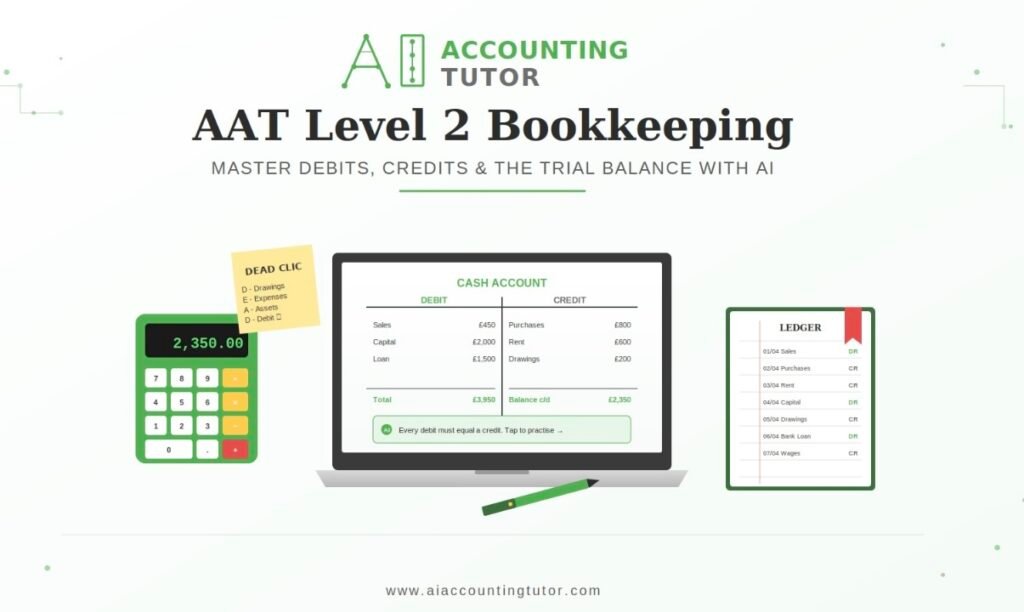
Starting AAT Level 2 bookkeeping can feel like learning a whole new language.
Debits, credits, journals, ledgers, control accounts, the trial balance — it all comes at you very quickly. Most students do not struggle because they are not capable. They struggle because AAT Level 2 bookkeeping is taught all at once, in a very condensed way, and one missed concept can knock everything else out of place.
That is exactly where AI can change how you study.
Instead of getting stuck on a single topic for days, you can use AI to break AAT Level 2 bookkeeping down into small, clear, repeatable steps. You can ask the same question three different ways. You can practise endlessly without judgement. And you can finally see why something works, not just be told that it does.
You can explore AI-powered support for accounting students here: AI Accounting Tutor.
AAT Level 2, also known as the AAT Level 2 Certificate in Accounting, is the foundation of every accounting career that follows. The topics you learn here — bookkeeping transactions, bookkeeping controls, costing principles and the business environment — are the building blocks for AAT Level 3, AAT Level 4 and beyond.
You can read more about the structure of the qualification on the official AAT website here: AAT Level 2 Certificate in Accounting.
The challenge is that AAT Level 2 bookkeeping is taught at a pace that assumes everyone keeps up. In reality, many students fall behind on debits and credits in week two and never fully catch up. Some give up entirely. Others memorise the rules without ever understanding the logic — which works until the exam asks something slightly different.
AI removes the most common Level 2 problem: not having someone available to explain the same thing five different ways at 9pm on a Tuesday.
If you only fix one thing in AAT Level 2 bookkeeping, fix debits and credits.
Almost every Level 2 mistake traces back to this. Students learn the rules (“debit the receiver, credit the giver” or “DEAD CLIC”) but never quite feel why a debit increases an asset and decreases a liability. Without that intuition, exam questions become guesswork.
AI Accounting Tutor lets you ask the same question over and over until it finally clicks:
Why is purchasing stock a debit? Why is paying a supplier a credit to the bank? Why does an expense sit on the debit side? Why does a sale credit the sales account?
You are not wasting anyone’s time. You are not embarrassed to ask again. And once debits and credits make sense, every other part of AAT Level 2 bookkeeping becomes dramatically easier.
Double-entry is the heart of AAT Level 2 bookkeeping.
Every transaction has two sides. Every entry must balance. And every exam will test whether you can apply that principle quickly and accurately under pressure.
The problem with traditional revision is that you eventually run out of practice questions, or you start memorising the answers rather than working them out.
AI removes that ceiling. You can generate fresh practice transactions endlessly:
A cash sale of £450 A credit purchase of inventory A drawing taken by the owner A part-payment to a supplier A bank loan received A cash refund issued to a customer
Each one becomes another chance to think through the entries, post them correctly and check your reasoning. That is the kind of repetition that turns AAT Level 2 bookkeeping from confusing to second nature.
The trial balance is one of the topics where students lose the most marks in AAT Level 2 bookkeeping.
It looks simple at first. List the balances. Make sure they agree. Job done. But under exam conditions, with errors deliberately built in, the trial balance becomes a test of patience and accuracy.
AI Accounting Tutor lets you walk through trial balance questions step by step. You can post entries, identify suspense account differences, correct errors and rework totals — without waiting until your next class to ask whether you got it right.
Even better, AI can show you why a particular error did or did not affect the trial balance. Some errors balance the books but are still wrong (errors of principle, errors of original entry, errors of commission). Understanding that distinction is exactly the kind of thinking AAT exams reward.
One of the slowest parts of traditional revision is the gap between making a mistake and understanding it.
You answer a question on Monday. Your tutor returns the work on Friday. By then, you have already moved on, and the lesson is half-forgotten.
AI closes that gap completely. You get feedback immediately — what you got wrong, why it was wrong, and how to think about it differently next time.
That is a small change with a huge impact on AAT Level 2 bookkeeping. Mistakes only help you when they are corrected while the thinking is still fresh.
Control accounts trip up so many students working through AAT Level 2 bookkeeping.
The sales ledger control account. The purchases ledger control account. Reconciling them to the individual receivable and payable balances. Spotting where errors might sit on either side. It is one of the more conceptually heavy topics on the syllabus.
AI Accounting Tutor can take you through a control account reconciliation slowly, in plain English, and let you ask each question that comes up along the way:
Why is this entry on the credit side? What does a contra entry actually do? Why is the discount allowed posted there? Where would a returned cheque appear?
When you finally get to the exam, you will have built the topic up in your head one careful piece at a time, instead of trying to memorise a whole template.
Bank reconciliations are another area in AAT Level 2 bookkeeping where small misunderstandings cause big problems.
You need to compare the cash book to the bank statement, identify timing differences, deal with unpresented cheques and outstanding lodgements, and adjust where needed. It sounds simple in theory and gets messy in practice.
Using AI, you can walk through full bank reconciliation examples with realistic data and ask the questions you would never ask in a busy classroom — like why a direct debit appears on the bank statement before it shows up in your records, or how to treat a bank charge you did not know about.
That kind of slow, patient practice builds the confidence you need to reconcile a real bank account in a real job, not just in an exam.
At AAT Level 2, your end-of-qualification synoptic assessment pulls together everything you have learned across AAT Level 2 bookkeeping, costing and the business environment.
That mix is what makes it hard. You are not being tested on one topic at a time anymore. You are being tested on whether you can apply different rules together, in context, under time pressure.
AI is well suited to this. You can ask for mixed-topic practice that crosses bookkeeping, controls and costing in one scenario. You can simulate the kind of judgement-based questions the synoptic loves to throw at you. And you can keep going until applying the rules feels natural rather than forced.
For more about how the assessment works, the official AAT page is a useful starting point: AAT assessments: how they work.
Most students do not fail AAT Level 2 bookkeeping because they are not clever enough. They fail because their study is inconsistent.
Three hours on Sunday is not the same as twenty minutes a day. Bookkeeping rewards repetition, and repetition rewards routine.
AI Accounting Tutor can become part of a small daily habit:
Five minutes reviewing yesterday’s mistakes Ten minutes practising fresh transactions Five minutes posting a quick mini trial balance
Done daily for four to six weeks, that habit alone will take you from “still not sure about debits and credits” to “I can post any transaction without thinking about it.” That is exactly the level of fluency the AAT Level 2 exam expects.
The whole point of using AI for AAT Level 2 bookkeeping is to give you the kind of patient, on-demand support that used to require a private tutor.
You can ask the same question five different ways. You can practise the same topic until it sinks in. You can have your mistakes explained the moment you make them. And you can do all of that without feeling rushed, embarrassed or behind the rest of the class.
For Level 2 students in particular, this matters. You are not just trying to pass an exam — you are building the foundation of every accounting qualification that follows. Get AAT Level 2 bookkeeping right and Level 3 will be easier. Get Level 3 right and Level 4 will feel manageable rather than overwhelming.
You can find more support for accounting students here: AI Accounting Tutor.
AAT Level 2 bookkeeping is not difficult because the topics are clever. It is difficult because so much depends on a few core ideas — debits and credits, the double-entry rule, the trial balance — and those ideas are usually taught too quickly for most students to absorb in real time.
AI gives you a way to slow that learning back down. To ask, to practise, to get it wrong without judgement, and to get it right again until the rules become instinctive.
If you are at the start of your AAT journey, this is the moment to invest in proper foundations. Master AAT Level 2 bookkeeping and the rest of the qualification stops feeling like a fight.
Find more support HERE.
You may also enjoy:
Support Team
I will be back soon


