Share this post:

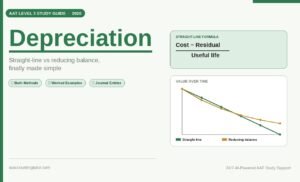 Depreciation is one of those accounting topics that sounds simple until you actually have to calculate it, at which point students discover there are two methods, a residual value to factor in, and a very common mistake that quietly loses marks in every exam sitting. It is a core year-end adjustment and appears reliably throughout AAT Level 3, so getting it right genuinely matters.
This guide explains what it is, why businesses do it, the two main methods with worked examples, the journal entries, and the single error that trips up more students than any other. If you have already worked through our guides to the trial balance and accruals and prepayments, this is the next core adjustment to master.
Depreciation is the process of spreading the cost of a non-current asset over its useful life, rather than charging the whole cost as an expense in the year it was bought. A non-current asset is something a business owns and uses over several years, such as a delivery van, machinery, or computer equipment.
The key idea is that these assets lose value as they are used, and that gradual loss of value is a genuine cost of running the business. Rather than pretending a £40,000 van is a £40,000 expense in year one and nothing thereafter, the cost is spread across every year the van is actually used. This charge is recorded as an expense in the profit and loss account each year.
There are two connected reasons, and both come back to giving a truthful picture of the business.
It gives a truer profit figure. If a business expensed a £40,000 van in full the year it was bought, that year’s profit would look artificially low, and every following year would look artificially high because the van appears to cost nothing despite still being used. Spreading the cost matches the expense to the years that actually benefit from the asset, which is the matching concept in action.
It gives a truer asset value. On the balance sheet, the asset is shown at its reducing value over time rather than its original cost forever, giving a more realistic picture of what the business actually owns. It is worth being clear on one point: it is not about the physical wearing out of the asset, but about allocating its cost over the period it is used.
AAT assessments focus on two methods. You need to be comfortable calculating both and knowing when each is appropriate.
Straight-line charges the same amount every year. It suits assets that give a steady benefit across their life, such as office furniture or fixtures and fittings.
Reducing balance charges a fixed percentage of the asset’s remaining value each year, so the charge is higher early on and smaller later. It suits assets that lose most of their value in the early years or are more productive when new, such as vehicles and IT equipment.
The straight-line formula is: (cost minus residual value) divided by useful life. Residual value is what the business expects the asset to be worth at the end of its useful life.
Example. A business buys machinery for £22,000. It expects to use it for five years, after which it should have a residual value of £2,000.
The calculation is (£22,000 minus £2,000) divided by 5, which is £20,000 divided by 5, giving £4,000 per year. That same £4,000 is charged every year for five years, at which point the accumulated total reaches £20,000 and the asset is left at its £2,000 residual value. Simple, even, and predictable.
The reducing balance method applies a fixed percentage, not to the original cost, but to the asset’s carrying value (also called net book value): the cost so far minus the amount already charged.
Example. A business buys a van for £20,000 and applies a rate of 25% reducing balance.
Notice how the charge shrinks each year, and how it is always calculated on the reducing carrying value, never on the original £20,000. That distinction is the whole point of the method, and it is exactly where students go wrong.
The single most common error in reducing balance questions is calculating the percentage on the original cost every year instead of on the carrying value. Applying 25% to £20,000 in year two gives £5,000, when the correct answer is 25% of £15,000, which is £3,750.
Always ask yourself: am I working from the original cost, or from the value after previous charges have been taken off? For reducing balance, it is always the reducing carrying value. Get that one habit right and you will avoid the mistake that costs more marks than any other in this topic.
However you calculate the charge, the double entry to record it is the same. Each year you:
Debit the depreciation expense account (also called the depreciation charge), which increases expenses in the profit and loss account and therefore reduces profit for the year.
Credit the accumulated depreciation account, which is a running total of everything charged on the asset to date. This sits on the statement of financial position and is deducted from the asset’s cost to show its carrying value.
This is why the charge never touches the original cost account directly. The cost stays fixed, and the separate accumulated account builds up alongside it. Carrying value is simply cost minus the accumulated total.
Understanding where each figure appears is essential for the AAT financial statements tasks.
One useful thing to understand is that this is a non-cash expense. It reduces reported profit, but no money actually leaves the business when it is charged, since the cash went out when the asset was originally bought. This is why the charge is added back when working from profit towards cash flow.
Yes, and this surprises many students. Over the full life of an asset, both the straight-line and reducing balance methods charge the same total. The difference is purely in the timing: reducing balance front-loads the expense into the early years, while straight-line spreads it evenly. The asset ends up at the same carrying value either way; the two methods simply take different routes to get there.
This is a core topic across AAT Level 3, especially the Financial Accounting: Preparing Financial Statements (FAPS) unit, where it appears both as standalone calculation tasks and as part of preparing a full set of financial statements. It also features in the extended trial balance as one of the year-end adjustments applied before the final accounts are produced.
If you are preparing for FAPS specifically, our dedicated guide on how to pass AAT FAPS covers the wider unit, and our guide to accruals and prepayments covers the other main year-end adjustment tested alongside it.
The reason this topic causes difficulty is that it combines a formula, a choice of method, and a running calculation across multiple years, all at once, with the reducing balance trap waiting at every step. That is exactly the kind of topic where practice with instant feedback makes the biggest difference.
AI Accounting Tutor lets you work through questions at your own pace, upload one you are stuck on, and get a clear step-by-step explanation of exactly which method to use, which value to apply the rate to, and why. This is core content for AAT Level 3, and once you are confident, you can test yourself under timed conditions using our guide to AAT mock exams.
Depreciation is the process of spreading the cost of a non-current asset, such as a vehicle or machinery, over its useful life, rather than charging the whole cost as an expense in the year of purchase. It is recorded as an expense each year to match the cost to the periods that benefit from the asset.
The two methods tested in AAT are straight-line, which charges the same amount each year, and reducing balance, which charges a fixed percentage of the asset’s carrying value each year so the charge is higher early on and smaller later.
The straight-line formula is (cost minus residual value) divided by useful life. For example, machinery costing £22,000 with a £2,000 residual value and a five-year life gives (£22,000 minus £2,000) divided by 5, which is £4,000 per year.
Reducing balance applies a fixed percentage to the asset’s carrying value (cost minus the amount already charged), not to the original cost. This produces a larger charge in early years and a smaller charge later, as the carrying value falls each year.
The most common error is applying the reducing balance percentage to the original cost every year instead of to the reducing carrying value. Always calculate the reducing balance charge on the value after previous charges have been deducted.
You debit the depreciation expense account (reducing profit) and credit the accumulated depreciation account (a running total on the statement of financial position). The original cost account is never touched directly by the entry.
Net book value, also called carrying value, is the asset’s original cost minus the accumulated amount charged to date. It represents the value at which the asset is shown on the statement of financial position.
No. It is a non-cash expense. It reduces reported profit, but no money leaves the business when it is charged, because the cash was spent when the asset was originally purchased. This is why it is added back when calculating cash flow from profit.
Yes, over the full life of the asset both methods charge the same total. The difference is only in timing: reducing balance front-loads the expense into early years, while straight-line spreads it evenly across every year.
It is a core year-end adjustment tested across AAT Level 3, especially in the Financial Accounting: Preparing Financial Statements unit. It appears as standalone calculations and within full financial statement questions, making it essential to master for the exam.
This article provides general educational guidance on depreciation for accounting and bookkeeping students. Always refer to current AAT study materials and assessment guidance for your specific unit.

Support Team
I will be back soon


