Share this post:

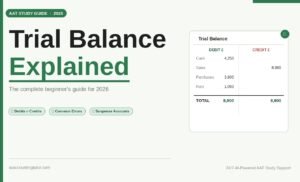 A trial balance is the checkpoint every set of accounts passes through before financial statements can be prepared. It is where you find out whether the double-entry bookkeeping behind your figures actually adds up, quite literally. For AAT students, understanding this document is not optional. It underpins Bookkeeping Controls, Advanced Bookkeeping, and everything that follows at Level 3 and Level 4.
This guide explains exactly what it is, how to prepare one, the errors that commonly throw it out of balance, and the errors that slip through even when the two columns agree perfectly. If you have already worked through our guide to double entry bookkeeping, this is the natural next step.
A trial balance is a list of every ledger account balance in a business at a specific point in time, arranged into two columns: debit and credit. Its purpose is simple but essential: to confirm that the total of every debit entry equals the total of every credit entry across the entire set of accounts.
Because double-entry bookkeeping requires every transaction to be recorded twice, once as a debit and once as a credit of equal value, the two columns of a correctly prepared report should always match. If they do not, something has gone wrong somewhere in the recording process, and this document is the tool that flags it before it reaches your financial statements.
A trial balance serves two distinct purposes, and both matter for different reasons.
It checks arithmetic accuracy. If your debits and credits do not match, you know immediately that an error exists somewhere in your ledger accounts. Without this check, errors could flow straight through into your financial statements undetected.
It is the starting point for adjustments. Once the report confirms your books are arithmetically sound, it becomes the foundation for year-end adjustments, accruals, prepayments, and depreciation, before the final Statement of Profit or Loss and Statement of Financial Position are prepared. The GOV.UK guidance on preparing accounts touches on how these adjustments feed into statutory reporting.
It is normally prepared at the end of an accounting period, whether that is monthly, quarterly, or annually, but it can be run at any point when you want to check the health of your ledger.
A trial balance is laid out as a simple two-column list. Each ledger account appears once, with its balance recorded in either the debit or credit column depending on the type of account and its normal balance.
As a general rule, accounts with these normal balances appear in the debit column:
And accounts with these normal balances appear in the credit column:
Once every balance is listed in its correct column, both columns are totalled. If the accounts have been recorded correctly throughout the period, the two totals will be identical.
Some errors will always show up because they cause the debit and credit columns to disagree. These are the errors AAT assessments most often test.
Single entry error. A debit entry has been made correctly, but the corresponding credit entry was never posted, or vice versa. Only one side of the double entry exists.
Casting error. A column of figures, or a ledger account balance, has simply been added up incorrectly. “Casting” means totalling, so this is an adding-up mistake.
Transposition error. Digits within a figure have been swapped around, so £369 is entered as £396. The tell-tale sign is that the difference between the two columns is always divisible by 9.
Extraction error. The wrong figure has been taken from a ledger account and carried across to the report, even though the underlying ledger entry itself was correct.
Two debits or two credits. Instead of one debit and one credit, both entries for a transaction have accidentally been posted to the same side.
When any of these occur, the difference between the two columns is temporarily posted to a suspense account so the report can still be balanced while the underlying error is investigated and corrected through journal entries. AAT’s own study resources cover this process in detail on the AAT qualifications and courses page.
This is the part that catches most students out. The two columns can agree perfectly and still contain real errors. These involve equal and opposite mistakes, so the totals still match, even though the accounts are wrong.
Error of omission. A transaction has been left out of the accounts entirely, in both the journal and the ledger. Because neither side was recorded, the columns still agree.
Error of commission. An entry has been posted to the wrong account, but the correct type of account. For example, a payment to one supplier is posted to a different supplier’s account by mistake.
Error of principle. An entry has been posted to the wrong category of account altogether, such as recording the purchase of equipment (a capital expense) as a revenue expense in the profit and loss account.
Error of original entry. The wrong figure was used from the very start, so both sides carry the same incorrect amount through the books.
Reversal of entries. The debit and credit have been recorded, but on the wrong sides of the correct accounts. Because the amounts match, the totals still agree despite the accounts being wrong.
Compensating errors. Two completely unrelated mistakes happen to cancel each other out by coincidence, hiding both from view at once.
When the two columns do not agree, a suspense account is opened temporarily to hold the value of the difference, allowing the figures to balance on paper while the real error is tracked down. Once the underlying mistake is identified, a correcting journal entry clears the suspense account back to zero and posts the correction to the right account.
A suspense account should never remain open at the end of a reporting period. Its entire purpose is temporary: to give you a working set of figures while you investigate, not to permanently hide a problem.
Rather than checking every account at random, work through possible causes systematically.
Check the difference amount first. If it is exactly divisible by 9, suspect a transposition error. If it is divisible by 2, check whether a figure has been entered on the wrong side rather than being omitted.
Re-cast your totals. Re-add both columns and the totals within individual ledger accounts before assuming the cause is something more complex.
Check that every ledger balance was transferred correctly. Compare each figure against the actual closing balance in the ledger account it came from.
Confirm every account has been included. A commonly missed account is an easy way for the figures to fall out of balance.
Trial balance questions in AAT assessments are practical by design. You are usually given a set of figures with a deliberate error built in, and asked to identify and correct it. This is a skill built through repeated practice, not memorisation.
AI Accounting Tutor lets you work through these scenarios at your own pace, upload a practice question you are stuck on, and get a step-by-step explanation of exactly where an error sits and why. Instead of staring at two columns that will not match, you get guided reasoning that builds the same investigative process examiners are testing.
This is particularly useful heading into AAT Level 2 Bookkeeping and AAT Level 3 assessments, where these questions appear consistently. Before your assessment, reinforce your preparation with our guide to AAT mock exams.
It is a list of every ledger account balance at a given date, split into debit and credit columns. Its purpose is to confirm that total debits equal total credits, checking the arithmetic accuracy of the double-entry bookkeeping behind the accounts.
It fails to balance when an error has occurred that affects only one side of the double entry, such as a single entry error, a casting error, a transposition error, or two entries posted to the same side. The unmatched amount is usually posted temporarily to a suspense account while the error is investigated.
Yes. Errors of omission, commission, principle, original entry, reversal, and compensating errors all leave the totals equal because both sides of the double entry are affected equally. These are undetected by this check alone and must be found through other means.
A suspense account is a temporary account used to hold the value of a difference between the two columns, allowing the figures to balance while the real underlying error is investigated. Once found, a correcting journal clears the suspense account.
It occurs when the digits of a figure are accidentally swapped, such as entering £369 as £396. A useful tell is that the resulting difference is always exactly divisible by 9.
Accounts with a normal debit balance appear on the debit side, including assets such as cash and receivables, expenses such as rent and wages, and drawings. Liabilities, income, and capital accounts normally appear on the credit side instead.
Typically at the end of each accounting period, whether monthly, quarterly, or annually, and always before financial statements are drawn up. It can also be run at any point to check the current state of the ledger.
No. This is an internal working document listing every ledger balance to check arithmetic accuracy. A balance sheet, or Statement of Financial Position, is a formal financial statement prepared afterwards, summarising assets, liabilities, and capital for external reporting.
It underpins AAT Bookkeeping Controls at Level 2 and Advanced Bookkeeping at Level 3. Identifying error types, correcting them through journals, and understanding suspense accounts are core, heavily examined skills that carry through into every level of the qualification.
Check whether the difference is divisible by 9 (suggesting transposition) or by 2 (suggesting a figure on the wrong side). Re-cast your column totals, verify every ledger balance has transferred correctly, and confirm no accounts have been missed entirely before assuming a more complex cause.
This article provides general educational guidance for AAT and bookkeeping students. Always refer to current AAT study materials and assessment guidance for your specific unit.

Support Team
I will be back soon


